Most sight word activities worth doing are doing one of two jobs: getting the child to look hard at the letters in a word, or getting them to read the same small set of words aloud more times than they otherwise would.
Those are the two mechanisms, and knowing which job an activity is doing is what separates a useful evening from one that fills a Tuesday. The seven below need index cards, a pen, and sometimes chalk. Each is the home version of a routine published by a practice guide, a state agency or a university literacy center.
The test to apply to any activity you meet elsewhere, including these: which job is it doing, and how many times does the child actually read a word out loud while playing it? An activity that produces two readings in twenty minutes may still be worthwhile word study, but it is not fluency practice and should not be counted as such.
Which words should be in the game?
Three to five of them, and preferably the ones from school.
That last point matters more than it sounds. There is no national sight word list in the United States and no correct order: districts and schools choose their own, which is why the family down the road has a different sheet. Practice the sheet you were given rather than one you found online.
The What Works Clearinghouse practice guide on foundational reading skills is consistent on set size. Its Star Words activity starts with three to five high-frequency words on individual cards. Johns and Wilke, writing in the Texas Journal of Literacy Education, use the same figure twice over: for the first session, choose three to five words to teach, and when those are secure, add the next three to five.
The practice guide gives the reason in its passage on words that cannot yet be sounded out. It recommends limiting how many are introduced at a time, because learning words holistically places considerable demands on a child’s memory. Twenty cards is not a more ambitious version of five cards. It is a different and worse activity.
One more thing before the games. Try sounding each word out before you decide it needs a game at all. The Texas Education Agency’s high-frequency word list warns teachers not to describe these words as non-decodable or irregular, because many of them contain very common spelling patterns. Most of the sheet will simply go. The games are for the residue. The five minute routine covers that first pass.
The ring
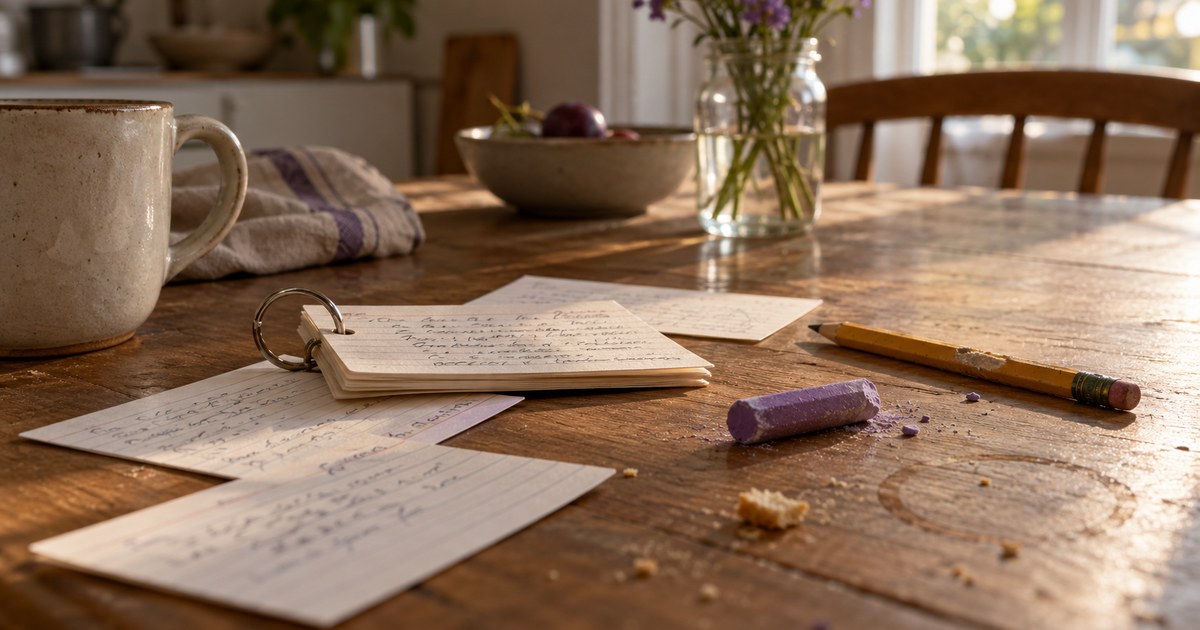
Materials: index cards cut in half, a pen, and a loose-leaf ring, a shoelace or a bulldog clip.
Write one word per card, put three to five on the ring, and leave it somewhere visible. Through the week, whoever is around asks the child to read the words on it. Each correct read earns a mark on that card. When every card has three marks, add new words.
This is the practice guide’s Star Words activity, copied almost exactly, and the guide explicitly names parents as among the other adults who do the asking. What makes it work is not the stars. It is that the ring is portable and the asking is distributed across days and people, which spreads the repetitions out instead of stacking them into one sitting.
Beat the clock
Materials: the cards you already made.
Show a card. If the word comes within three seconds, it goes on the child’s pile. If it does not, you say the word and it goes on your pile. Go through again with two seconds, then one, then as fast as you can turn them. At the end, reteach everything left on your pile.
This is the practice guide’s flashcard procedure, which specifies exactly that: identify the word within three seconds, then two, then one, then immediately, with a teacher pile and a student pile, and reteaching at the end for the words that landed on the teacher pile. Johns and Wilke use the same one-second threshold as the mark of a word known by sight.
The shrinking clock is the whole point. Accuracy gets a word into memory; speed is what makes it useful in a sentence. The sight word flashcards page has more on using cards without turning them into a drill.
The envelope
Materials: one envelope, the cards.
Words the child has learned live inside the envelope. Words still being worked on are clipped to the outside. Every session, start by reviewing the newly learned words, then tip the known ones out and read the whole pile for speed. Anything that stalls comes back out to the clip.
Johns and Wilke describe this system step by step, and it solves the problem every parent eventually hits, which is that a word learned in October quietly goes missing in January. The known pile keeps getting revisited at no extra cost, because reading twenty already-fast words takes about forty seconds.
Chant and clap
Materials: none beyond the cards.
Say the word while pointing at it. The child writes it on a card, then chants the word, then chants the spelling, clapping or tapping a foot along with the spelling chant. Do that for each of the three to five words, then point at one at random and see whether the chant comes without hesitation.
This is Johns and Wilke’s see, hear, write, chant routine, and they suggest running it during a movement break rather than at a table. It is the most physical thing on this list and the one that works best with a child who will not sit down.
Words everywhere
Materials: sidewalk chalk, or magnetic letters and a baking sheet, or a tray of sand, or play dough.
Write the week’s words outside in chalk and have the child read them as they jump between them. Build them from magnetic letters on a baking sheet. Trace them with a finger in a tray of sand or rice. Roll them out of play dough.
Johns and Wilke list all four, and it is worth being straight about what they are doing. Forming a word from letters is not a magic multisensory shortcut; it is a slow, attention-heavy way of looking hard at the letter sequence, which is the thing the child needs to look hard at. The University of Florida Literacy Institute’s guidance points the same way: an irregular word is introduced by sounding out the decodable parts and recognizing the part that has to be learned by heart, and flashcards then become an effective tool for practice once that has happened. Building the word is instruction. The cards are the repetitions.
If a child builds four words in half an hour and reads each once, the activity has been pleasant and has taught very little. Pair it with a round of the cards.
Read my mind
Materials: the cards, laid face up.
Pick a word secretly and give five clues, narrowing as you go. It is one of our words. It has three letters. It begins with o. It is the opposite of young. It is missing from this sentence: today I am seven years ______.
Johns and Wilke include this one, crediting Cunningham, and the example above is close to theirs. It is the only activity here that asks the child to think about what a word means rather than only how it looks, which matters for the small, abstract words that are hardest to picture.
Hide and seek
Materials: the cards, and a house.
Hide the word cards around a room and send the child to find them. Every card found has to be read aloud before it counts. Ten cards hidden twice is twenty readings, which is a respectable evening.
Johns and Wilke describe the classroom version as a treasure hunt. The home version is better, because you can hide them in the hall while the child is brushing their teeth.
Do the games actually work?
The evidence here is weaker than for the instruction, and it is worth saying so rather than overselling it.
Johns and Wilke report that research has found sight word intervention games to be highly effective for sight word achievement, citing work by Gibbon and colleagues. That is a real finding and it is one study’s worth of support inside a practical article, which is a different weight of evidence from the practice guide’s strong rating for decoding instruction itself.
The safest reading is the modest one. Games are a delivery mechanism for repetitions. A child who reads the same five words forty times across a week in six different formats has had a good week, and the format is mostly a way of making forty repetitions survivable for both of you.
What games do not replace is reading. The practice guide’s own step after quick recognition is reading the words in connected text, and Johns and Wilke end their routine by putting the words into phrases and sentences to promote transfer to context. Finish on a sentence or a page of a real book, every time. The kindergarten sight words page holds the lists most often used at this stage, and the sight words pillar covers how those lists relate. For practice with no table at all, see sight words practice without a table.
The one thing none of these games can do is say the word. Sight Words Vocabulary Builder holds 94 high-frequency words in four stages, each inside a short sentence, and a tap plays the word and the sentence aloud. It is free and has no ads. It earns its place on the evening you are not certain how a word should sound, or when the person doing the asking is not you.
Seven games, one mechanism. Small set, many readings, spread across days, finishing in a sentence. Everything else is decoration, and decoration is fine as long as you know which part is doing the work.
Sources
- Foundational Skills to Support Reading for Understanding in Kindergarten Through 3rd Grade, NCEE 2016-4008, What Works Clearinghouse, Institute of Education Sciences, 2016
- High-Frequency Words: Some Ways to Teach and Help Students Practice and Learn Them, Johns JL and Wilke KH, Texas Journal of Literacy Education volume 6 number 1, 2018
- Irregular and High Frequency Words, University of Florida Literacy Institute
- High-Frequency Word List, word analysis by Devin Kearns, Texas Education Agency, 2021